
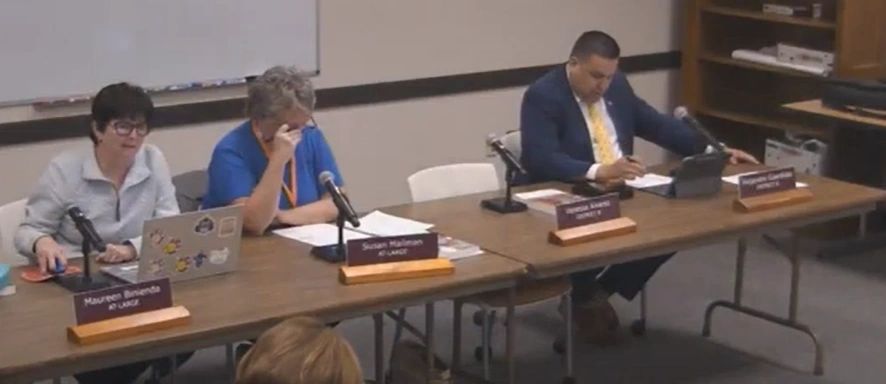
WORCESTER—A report from the superintendent and her team on “A Sense of Belonging: Climate, Culture & Safety” relating to the district’s student discipline policy prompted a barrage of questions at Thursday’s meeting of the Worcester School Committee.
It also produced a disagreement between Maureen Binienda and Rachel H. Monárrez, who succeeded her in the position.
A presentation by several of Monárrez’s lieutenants focused on steps that have been taken over the past two years to make safety a priority for staff and students. A “Safe & Free Education,” or S.A.F.E.
“Breakthrough strategies are more refined and operating more effectively,” and overall progress is being made, the committee was told.
“We focus on discipline as a learning opportunity for students,” Shannon Conley said. Inclusivity is a goal and “suspensions are a last resort.” Conley is executive director of school discipline.
Out-of-school suspensions as of school day 50 for middle schools and high schools ticked downward from 309 to 255 year-to-year, while in-school suspensions rose from 82 to 136, mostly at the high school level. The most common incidents for out-of-school suspensions were physical assault-student, 21%, and fighting, 19%.
The presentation concluded with “the Burncoat High School story” as an example of taking advantage of a partnership with the RISE program and targeted intervention to generate positive outcomes.
“You can have a positive school climate and hold students accountable,” Monárrez said, in summation. “It’s a lot of work and a lot of hard work. We are getting to see the results in the academics.”
The discussion shifted focus as Binienda raised questions about the effectiveness of Monárrez’s approach to restorative practices in addressing student discipline.
After citing numbers of all offenses resulting in in-school or out-of-school suspensions for such activity as physical assaults and drugs, Binienda asserted that “staff members are afraid. Restorative justice is not working in all schools. Teachers do not come to school to break up fights.”
School adjustment counselors are now being saddled with duties previously handled by personnel who are no longer with the district, Binienda said.
“Students are asking teachers ‘why are disruptive students ruining our learning?’”
“We have a policy,” Binienda said, in suggesting that the policy was not being enforced strongly enough in disciplining unruly students. She asked about the status of the Woodward Day School and Challenge & Reach.
Monárrez responded to Binienda’s criticism by citing statistics.
“When I arrived there were 379 long-term suspensions out of school, grades 7-12, a 3% rate,” Monárrez said. “Some children emailed me asking ‘please give me another chance.’ Children I knew nothing about. Morally it’s our responsibility to educate them. We are 1% now. I stop and ask myself ‘what is the reason for this and what can we do?’ In my first month I had to attend a memorial” involving “children sent off to another setting. One of those sent away is still struggling. Children make mistakes. I will not be a superintendent who throws children away.”
Molly McCullough, Susan B. Mailman, Jermaine Johnson, Alex Guardiola, Vanessa Alvarez, Dianna Biancheria, Kathy Roy and Mayor Joseph M. Petty all weighed in. Johnson made a motion for more data on wellness rooms being utilized for safety. He also asked what reasons might be behind the emergency removal of students in elementary schools.
Johnson defended the superintendent, adding, “This is not a back-and-forth on who did a better job. We have to be better as a district and as a school committee body.”
McCullough questioned how alternative programs are selected and “how does the student get back to a traditional setting?”
Biancheria had a number of questions about wellness room staffing and usage numbers and the purpose of wellness rooms. She made a motion for updated statistics on these, preferably by January. She also asked “how do we track how the victim of the circumstances” involving a physical assault is doing? She was told by Monárrez that whoever perpetrated the incident “has to mend that with the person victimized. That is what restorative practice is about.”
Biancheria wondered why there was no mention of weapons in the report, and was told this information could be provided.
Roy asked “if a child is found with a weapon, what is the procedure?” She was told the police are notified and a charge is filed.
As if in anticipation of it being asked, Monárrez said “there is no gun on campus this year.” She did note that “air-softs,” which she described as “like a BB gun,” have been seen, apparently “to make a kid look tough.”
Rod Lee is a career journalist, a veteran of the media scene in Central Massachusetts and the author of seven books including the recently published “Gil Cristopher,” a novel about the difficulties associated with aging. He can be contacted at rodlee1963@gmail.com