
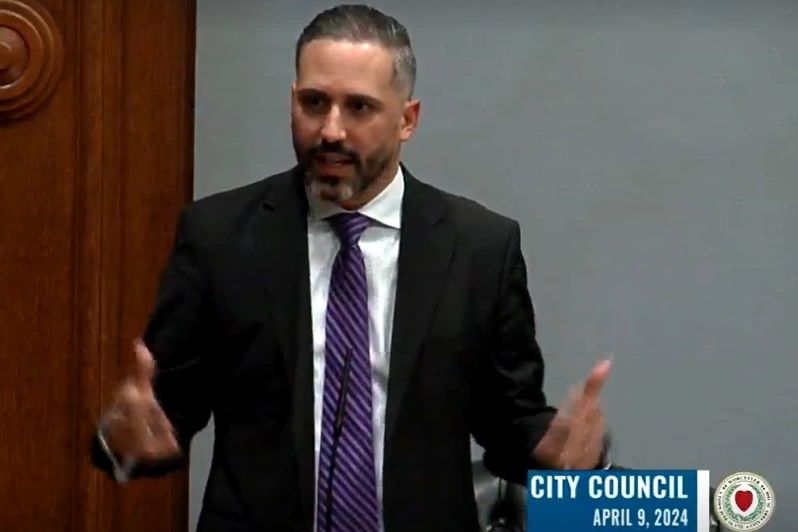
WORCESTER—Despite two years of intense work and discussion over an idea on which most city councilors agree, at least in principle, the city’s Rental Registration Program stumbled this week, largely over privacy concerns and questions of constitutionality.
Its roots dating back to 2019 and the early days following the tragic death of a city firefighter in a Lowell Street multifamily building, the program was officially approved in 2022 and rolled out to landlords and tenants last month, when it encountered significant headwinds of opposition largely rooted in what was seen as exorbitant fees and how the program might impact city tenants.
On Tuesday night, the city council was asked to approve an order to publicly advertise some changes City Manager Eric D. Batista suggested for the program, to include lowering the proposed fines against landlords who don’t comply with the policy from $300 per day to $200 per month.
Instead, several members of the council, including Mayor Joseph M. Petty, pledged support for the program but also asked for a legal review before they’d officially vote, potentially at the council’s meeting next month.
At-Large City Councilor Morris A. Bergman seemed most concerned about the ordinance’s Constitutional grounding, saying that his own initial research had revealed challenges to similar programs around the country, some of which he said had been successful.
Bergman said he was “troubled” by the uncertainty over whether it would be legal for city inspectors to gain entry to an apartment without some kind of probably cause.
Batista pointed out that all inspections would be scheduled and at times convenient for landlords and their tenants.
“We’re not going to just randomly show up and barge into somebody’s unit,” he said.
Even though the eventually successful motion to send the order back to the city’s Economic Development committee was his, Petty made clear that he supports the program, he just wants to be on solid legal ground.
“At the end of the day…it’s about the safety of the people that live in Worcester, it’s also about the safety of our firefighters and inspectional services people,” he said.
Petty noted that the city has some of the oldest housing stock in the country, much of it languishing under the burden of millions of dollars’ worth of long-deferred maintenance, an observation that distilled the main arguments he and other councilors made in support of the program that centered on public safety for those working or living in those buildings.
Recent events, often with tragic consequences, were clearly on the minds of city leaders attempting to wrap their arms around two potentially competing ideas: surveillance and inspection of city rental properties and holding landlords accountable for the conditions of their properties, versus privacy and tenants’ rights.
Its proponents say the aim of the program is to build a structured system allowing direct communication between the city and property owners, and to establish a way to manage and pay for the increased number of property health and safety inspections.
The genesis of the Worcester registration program—one of an increasing list of cities nationwide enacting similar oversight rules—came in a 2019 proposal, less than a year after Worcester Firefighter Christopher Roy died fighting a five-alarm fire at a multifamily apartment on Lowell Street.
Three years later, 2022 proved to be a tough one for Worcester apartment buildings.
In May, four residents of a complex at 2 Gage Street died in a fire later deemed arson. A former building resident, Yvone Ngoiri, has been charged with four counts of second-degree murder, two counts of arson, two counts of assault and battery with a dangerous weapon, and a single count of assault and battery with a dangerous weapon causing bodily harm.
In July of that same year, the roof of a 32-unit apartment building at 267 Mill Street collapsed onto the second and third floors of the building, forcing the evacuation of the tenants. Fortunately, no serious injuries were reported.
The latest sticking point for a program that’s been at times poorly received by city landlords and tenants and cited during this week’s city council meeting included privacy concerns and questions ovetr whether the program can pass Constitutional muster if challenged.
One hypothetical that echoed Bergman’s question over legally accessing these spaces was the unanswered quandary that could face city health inspectors caught between the hard place of their jobs and the theoretical rock of inadvertently uncovering illegal acts or conditions in the course of their inspections.
Khrystian E. King, an at-large member of the council and it’s vice chairman, asked the city Legal Department Tuesday for a ruling on this conundrum.
“Will inspectors [have to] turn a blind eye” when they find potential illegalities during their inspections, he asked Christopher Spencer, head of the city’s Inspection Services division, which is tasked with implementing visits and inspections under the program.
Spencer told King that that question is “being reviewed legally,” a reply that led King to express his dissatisfaction at the number of unanswered questions he has about the program overall, including the lack of a policy to officially define or identify a “high risk property,” little information on staffing requirements for the additional required inspectors, and around clearing the current backlog of so-called “110 inspections,” so-called after the section of state regulations outlining health and safety requirements for building occupancy.
He said he had reservations that the council could “execute this in a way that folks who support this want us to. I really think we should be going back to the drawing board.”
King said he would not vote for the motion to publicly advertise the proposed changes to the program without answers to his questions, but voted unanimously with the council’s decision to send the motion back to the Economic Development Committee for more work.
Rental Registration Programs are often contentious at the outset, and Worcester’s is no exception.
Unveiled at a summit in early March with local landlords, the program received early intense criticism mostly around the fees, which some commenters felt exorbitant. Batista’s changes include decreasing landlords’ noncompliance fines from $300 per day to $200 per month.
Boston has had a similar program in place since 2013, although their program includes exemptions for government-owned buildings or multi-family dwellings with six or fewer units and where the building owner is one of the residents.
Nationally, rental registration programs have faced challenges.
According to the Wyoming Business Report, for example, in August 2022, a district judge in Laramie ruled that a rental registration program there was “unconstitutionally vague” in the way it proposed to register apartments, among other things.
The challenge, brought by a local property management company, was eventually overturned on appeal, and the registration rules in Laramie remain in effect.
For now, city councilors will regroup and attempt to find a clear path forward for the program, one which despite the most recent hesitancy every councilor has backed publicly.
As the Worcester Guardian marks six months of delivering free, independent digital news to our city, our dedication to this mission strengthens. Please consider a tax-deductible donation to support our ongoing commitment to providing hyperlocal news coverage to Worcester.
