
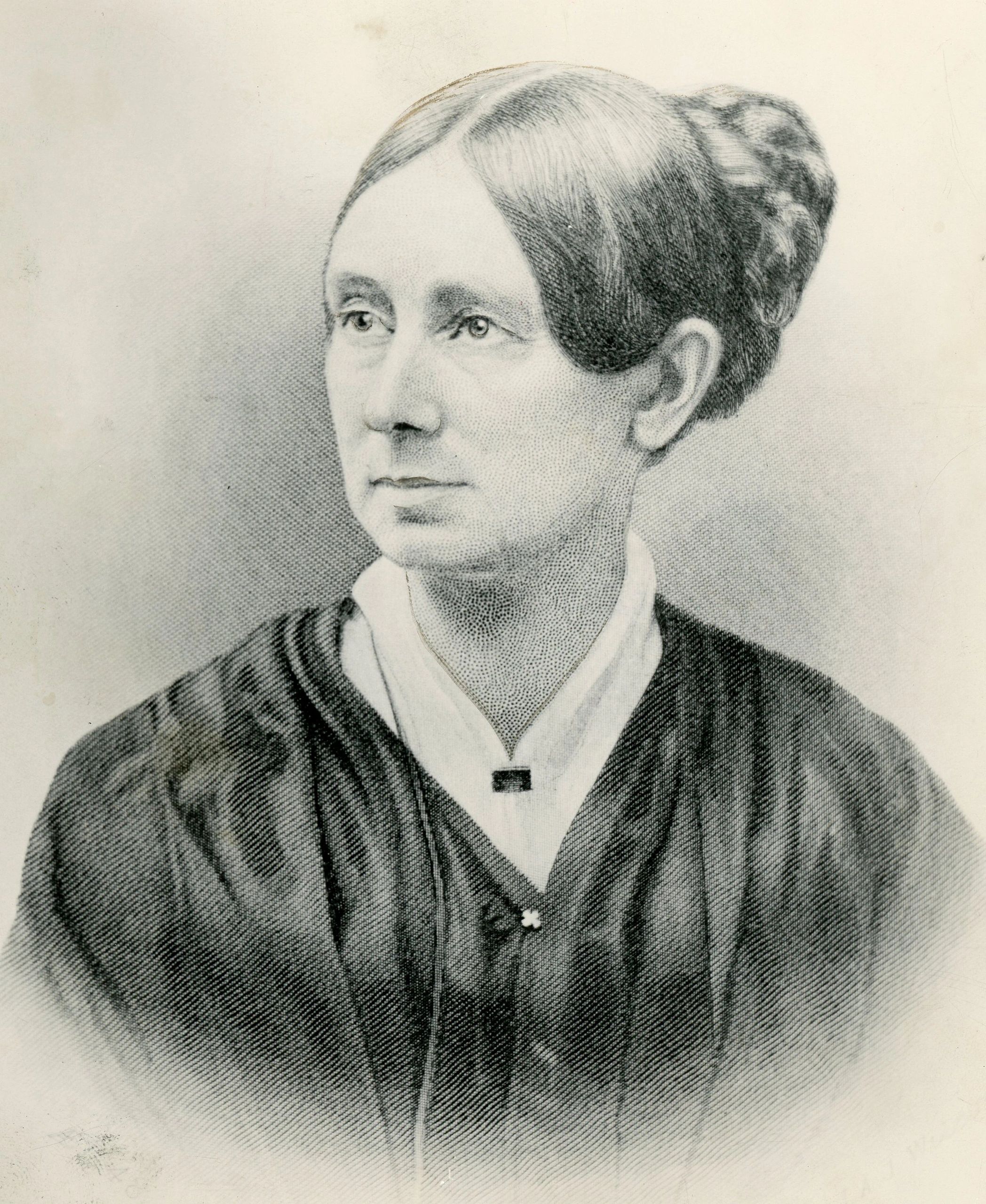
WORCESTER—Dorothea Dix was born on April 4,1802, in what is now Maine but was then considered the frontier of Massachusetts.
When she was ten years old, her father, Joseph Dix, shuffled the family down to Worcester to escape the British burning of Charlestown.
Dix had a tumultuous childhood and moved again to live with her grandparents in Boston when she was 12. By the time she was 14, she was back in Worcester, this time living with her aunt.
As a newly transplanted teen, Dix began her own school for girls in Worcester. She designed her own curriculum focusing on religion, poetry, and natural sciences. At 19 years old, she opened yet another school in Boston where she continued teaching for nearly 20 years, work that was only interrupted by her lifelong health struggles. When she finally withdrew from teaching, she traveled overseas to England. While in England, Dix met with reformers working to improve conditions and treatment for the mentally ill.
After two years in England, she returned to Boston and was soon thereafter invited to begin teaching Sunday school classes at a prison in East Cambridge. She had neither the constitution for such work nor the financial need for it but she accepted anyway. Dix was a devout Unitarian and felt a sincere obligation to do good and improve society.
It is generally agreed upon that her first visit to the prison in East Cambridge on March 28, 1841, was the turning point in Dix’s life. Seeing the abysmal conditions in which incarcerated people were kept had a profound impact on Dix. Many were unclothed, unwashed, and chained to the wall for years. Moreover, the severity and condition of their incarceration did not reliably track culpability or cause of incarceration. Many were in prison simply due to mental illness.
After being rebuffed by a local court, Dix began to travel all over the state to visit and survey all the jails, prisons, and poorhouses. She published her findings in a comprehensive and explicit report published in January 1843. It was her relentless research and advocacy that helped pass legislature to improve conditions at the Worcester Insane Asylum and nearly triple its capacity.
The report continued to get published as a pamphlet and was picked up by newspapers all over New England. After her success in Worcester, Dix continued her work all over the country and parts of Canada. Throughout her advocacy, Dix played an essential role in founding more than 30 mental hospitals. Indirectly, she was a key advocate in changing the landscape of mental health in the 19th century. When she began her work in 1843, there were only 13 mental hospitals in the country. By the turn of the century, there were 123.
Often referred to as the “voice of the mad,” Dix was an unwavering force for her cause and the embodiment of grassroots organizing. Though she traveled quite a bit during her life, Worcester served as a touchstone for some of her most important moments.
It was in Worcester that she began her teaching career, and later Worcester’s Insane Asylum was the first big victory in her life as an activist. Dix died on July 17, 1887, after convalescing in a Trenton hospital that she founded.
This is the first in a new series in collaboration with the Worcester Historical Society and the American Antiquarian Society to bring our readers Worcester history one person, place, or thing at a time. This is neither History nor Herstory. This is Worcestory, where we dive into Worcester’s lore. Tune in every week to see what we (un)cover.
Irena Kaci is a poet and writer living in Worcester, MA with her spouse and two children. She moved to Worcester in 2015, almost a decade after graduating from Clark University. She writes for The Pulse, SevenPonds and the Worcester Guardian. Her creative work has appeared in the Worcester Review, Atticus Review and the 45 Journal. She can be reached at irena.kaci@gmail.com