
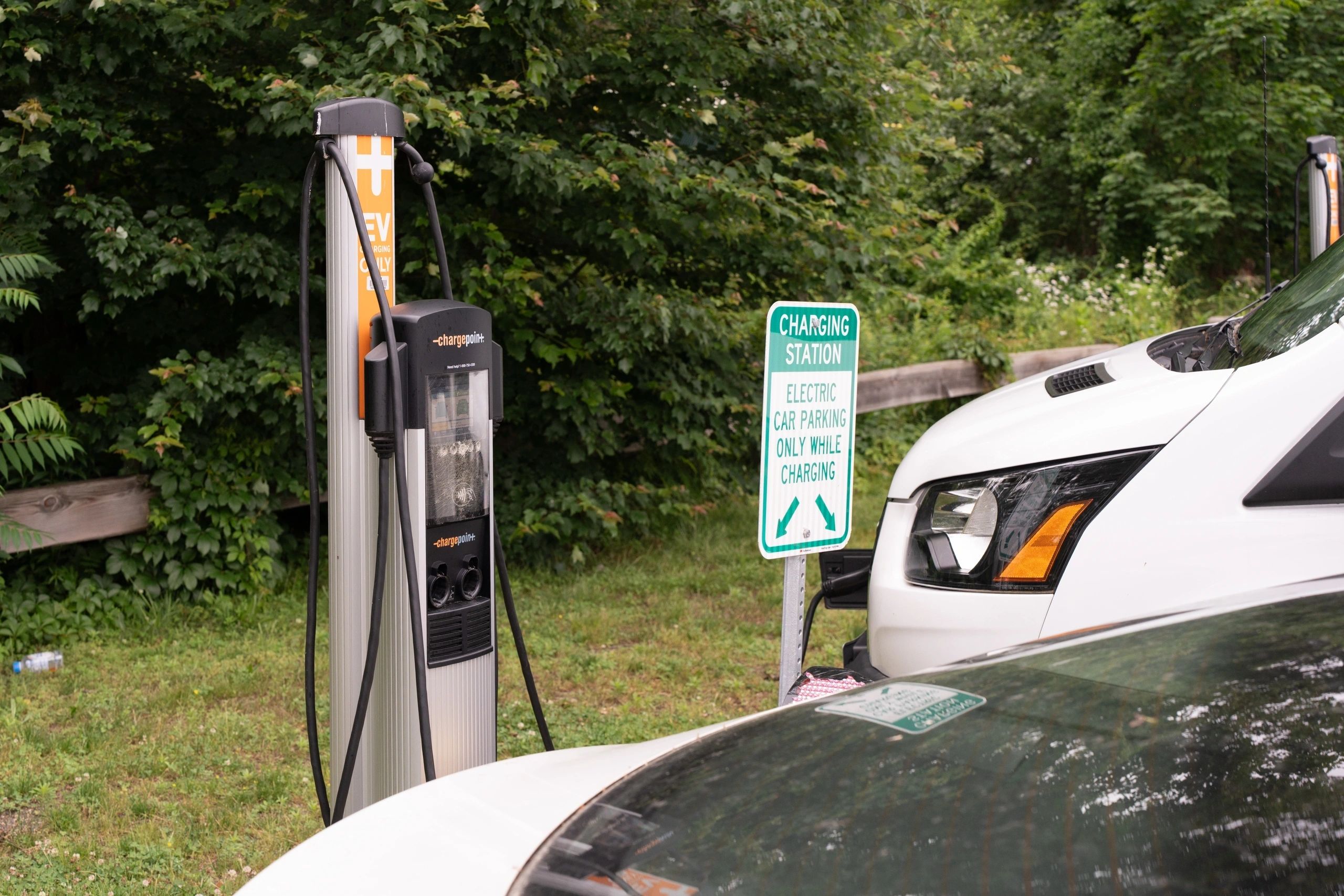
WORCESTER—Electric vehicle registrations in Worcester have surged 376% between 2017 and 2022, rising from 133 to 633 vehicles.
However, residents such as Patricia Hobbs say the city’s charging infrastructure hasn’t kept pace with demand.
When her son first started visiting Worcester with his electric vehicle seven years ago, he had to drive to the Auburn Mall just to find a charging station.
“For a city of our size, the city is still lacking in an adequate number of public charging stations,” Hobbs said, even as charging stations have become more available at gas stations and parking garages across Massachusetts’ second-largest city.
More chargers — and more input — coming
The city is working to bridge this gap through its Green Worcester Plan, having installed 20 new public EV charging stations since 2022 and added three electric vehicles to its municipal fleet. Currently, the city maintains 30 charging stations, with 24 located in parking garages and six at South High Community School.
Sarah Mount, energy analyst at the Department of Sustainability and Resilience, reported that more charging stations are on the way.
“We received a grant from Mass CEC to install on-street curbside EV charging stations across the city. We’re going to be installing them in three to five locations, and we have a crowdsource map where we’re collecting public input,” Mount said.
Chief Sustainability Officer John Odell told the Worcester Guardian the city is actively installing 10 to 15 new on-street charging ports, expected to be completed by the end of 2026.
“These new chargers will complement the 30 existing public EV charging ports located in municipal garages and parking lots,” he said. “We also have short and long-term plans for expanding our stations, depending on availability of funding and staff.”
Odell emphasized that equity and data are central to deciding where new chargers go. “We are taking a data-informed, equity-focused approach to site selection,” he said, noting that factors include community input, technical feasibility, and proximity to Environmental Justice neighborhoods. “The current round of installations is supported by a MassCEC grant, which requires that chargers be located in EJ neighborhoods close to multi-family homes.”
Regulations and incentives fuel long-term planning
The expansion of charging infrastructure is part of a broader initiative that includes the complete electrification of public transportation and updated building regulations. By 2025, all city-owned parking lots with more than 20 spaces must offer public EV charging, while new multifamily developments with five or more units will need to include EV-ready spaces. The Worcester Regional Transit Authority (WRTA) has committed to transitioning its entire bus fleet to electric by 2035.
Odell said the city’s electrification work is backed by several funding streams. “The current on-street charging installations are funded by the Massachusetts Clean Energy Center (MassCEC) through its On-Street Charging Solutions Program,” he said, adding that Worcester is also pursuing MassEVIP grants, MassSave incentives, and using its Carbon Mitigation Revolving Fund for upkeep.
“Expanding EV infrastructure is a key strategy within the Green Worcester Plan,” Odell added. “Transportation is the second largest source of greenhouse gas emissions in Worcester, making it a priority area for climate action.” According to the city’s most recent emissions inventory, transportation accounts for 31% of community-wide emissions and 16% of municipal emissions.
Community buy-in and concerns
However, some residents express mixed feelings about the EV transition.
“I found that I really didn’t save any money by charging the battery versus purchasing gasoline,” said Maureen Schwab, a Worcester resident who owns a hybrid car. “I stopped charging at home once I figured this out.”
While supporting the environmental benefits of EVs, Schwab added, “Having the charge you need when you need it is still not as easy as having gas in your tank if the power goes out. I like that security.”
Others are more optimistic — and hopeful for faster momentum.
“I drive a hybrid Prius (2010). As soon as it dies, we’ll get an EV,” said Sarah Luria, a Holy Cross professor. “I’d love to see the infrastructure developed. That said, the backing off of EVs by the market/government just now is so unfortunate. It won’t make them any cheaper and so less easy for Worcester residents to afford.”
Luria said visibility and education are essential. “I think more EV chargers would put EVs more in people’s consciousness and encourage them to think of purchasing one,” she said. “Publicizing the EV chargers would be great. Also good would be succinct ad campaigns that make the case for why EVs are so important for Worcester. We have densely settled neighborhoods with more and more cars.”
Advisory committee and public outreach underway
The Green Worcester Advisory Committee, formed in 2022 to oversee the city’s sustainability goals, continues to engage with residents about these concerns. Their next public meeting is scheduled for July 28, providing an opportunity for community input on the city’s electrification efforts.
Odell said public feedback is helping guide the process. “We launched a public crowdsourcing map in May 2025, which has already received over 120 submissions from community members identifying where they would like to see EV charging stations installed. This input is directly informing the siting process … and will continue to shape future phases.”
The Department of Sustainability and Resilience is also increasing its community outreach.
“We’re partnering with 311 to do walk-in office hours at their customer service center on 799 Main Street,” said Mount. “We’re doing those on Tuesday, July 8, from 3–5:30 p.m. and there’s no appointment necessary.”
Additionally, the department is collaborating with the Green Energy Consumer Alliance to host a webinar for landlords about energy efficiency and heat pump upgrades.
“Solar, nuclear and wind power are going to move us ahead by providing sources for electricity that are environmentally friendly, but it will take time,” Schwab said.
Matt Olszewski is a freelance content and news writer based in Boston, MA. In his free time, Matt enjoys running, hiking or skiing. Matt recently graduated with his MPH from Tufts University. He can be reached at mattoskier@gmail.com