
WORCESTER—Fifth graders in four Worcester elementary schools are learning about climate change not just from textbooks, but by redesigning their own neighborhoods—sometimes with fewer cars and more riverside boat traffic.
New England Botanic Garden at Tower Hill has expanded its Growing Green youth education program to three additional Worcester Public Schools, building on a pilot launched in 2022. This year, 121 students across eight classrooms are participating in the five-week program, which is offered free to Worcester Public Schools through support from external funders, representatives of the garden told the Worcester Guardian.
Originally launched at Goddard School of Science and Technology, Growing Green returned there this winter and now also serves Canterbury Street Magnet Computer-Based School, Jacob Hiatt Magnet School and Wawecus Road School, according to the garden.
The expansion focused on elementary schools where administrators expressed interest and where factors such as location and testing data suggested the lessons would be especially helpful and relevant to students, a spokesperson said.
The curriculum includes five weekly lessons aligned with Next Generation Science and Massachusetts science and engineering standards. Garden educators typically visit each classroom once a week, guiding students through discussions, hands-on activities and collaborative projects centered on climate science, the urban water cycle and environmental justice.
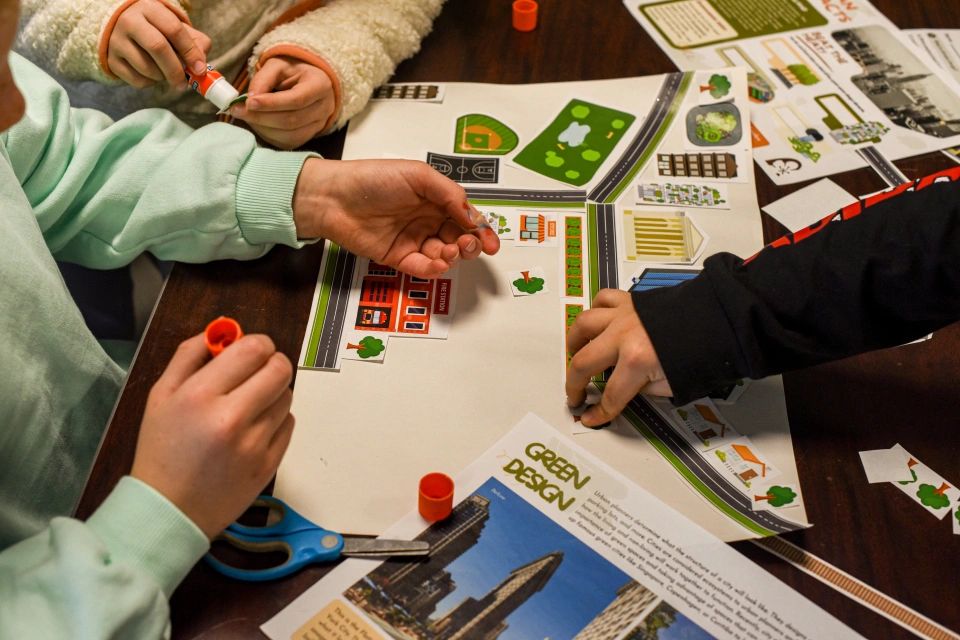
Students are introduced to eight green design solutions commonly used in cities, from green roofs to street trees, and then asked to apply what they’ve learned to their own communities. Working in teams, they decide which features to include in a redesigned version of their neighborhood, where to place them and how many to add.
In one classroom exercise, a group chose to eliminate cars and parking lots entirely to maximize green space and reduce emissions. When asked how residents would get around, the students proposed traveling along rivers by boat or biking on nearby trails.
The program aims not only to build scientific literacy but also to offer a constructive outlet for young people who may feel overwhelmed by climate change. “Growing Green brings hands-on science education into fifth grade classrooms and provides teachers with resources to engage students with some of the most important environmental challenges of our day,” Marissa Gallant, the botanic garden’s director of education, said in an announcement. She added that “connecting young people to the natural world and inspiring them to be planet protectors is an important part of the Garden’s mission.”
Aiden Duffy, the garden’s community education coordinator, said in the announcement that addressing climate anxiety is a key goal. “One of our biggest goals is to build awareness about climate change and inspire students with the things we can do to alleviate the disproportionate impacts we’re seeing across communities,” Duffy said. “Climate anxiety is an increasingly big concern for young kids. Growing Green offers a way to try to address it that’s not all doom and gloom.”
Erin Severens, a grade 5 teacher at Goddard School of Science and Technology, said the program helps students connect scientific concepts to their daily lives. “The students engage with hands-on activities and topics that they can see and feel in the neighborhoods around them every day,” she said in a statement. “Seeing them make these connections through the Growing Green curriculum has been incredibly rewarding.”
Support for the program at Goddard School is provided by the Worcester Garden Club, and the broader expansion is funded by The Hanover Insurance Group Foundation, according to the garden. At present, funding supports eight classrooms, but garden officials said they hope to expand to additional Worcester Public Schools if more funding becomes available.
While Growing Green does not include a visit to the botanic garden, all Worcester Public Schools second graders participate in a field trip to the garden through the Culture LEAP initiative of the Worcester Education Development Fund. At the end of that trip, each student receives four free general admission tickets to return with their families.
“New England Botanic Garden at Tower Hill is committed to being a strong community partner,” said Duffy. “When schools add Growing Green to their curriculum, we make it easy for teachers and administrators by bringing lessons directly into classrooms and providing hands-on learning tools they may not otherwise have access to. Since launching as a pilot, we’ve refined the program and are ready to engage even more Worcester students in these timely and important topics.”
Have news, tips, or a story worth telling? Reach Editor Charlene Arsenault at carsenault@theworcesterguardian.org—because good stories (and great scoops) deserve to be shared.
The Worcester Guardian is an independent nonprofit news organization. Support local journalism by making a DONATION today.