
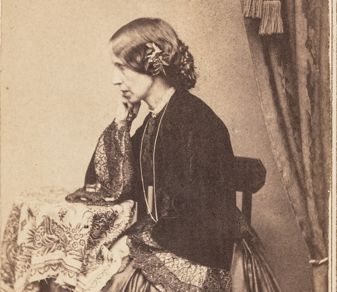
WORCESTER—Between 1863 and 1869 Lucy and Sarah Chase of Worcester taught throughout the South in schools for formerly enslaved Black people. They cultivated close relationships with their students, exchanging letters during and after the Civil War. Preserved at the American Antiquarian Society (AAS), those letters give rare first-hand accounts of life for African Americans—before and after they were emancipated―during the war and the early years of Reconstruction.
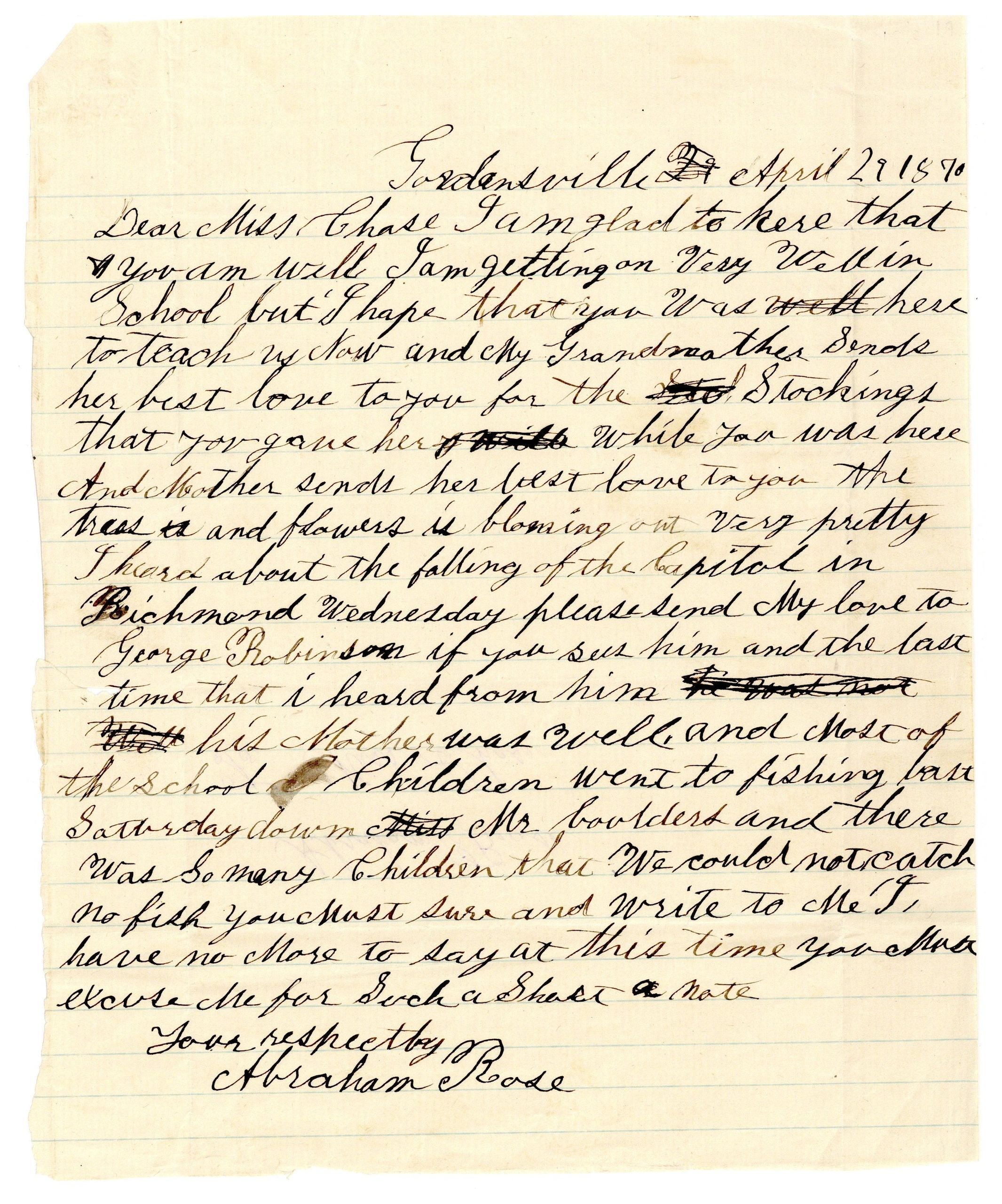
One note written in thick cursive on lined paper, addressed to Lucy and dated April 19, 1870, must have made her smile. The author, Abraham Rose of Gordonsville, Virginia, wrote, “. . .most of the School Children went to fishing last Saturday. . .and there was So many Children that We could not catch no fish.”
Many of the letters, however, relayed more serious news, such as the horrific atrocities committed against Black people after the war. In a fine, elegant script S.L. Rafe, whom Lucy taught in Lake City, Florida, recounted that “. . .in consequence of the outrages pepetrated by the Kue Klucks there has ben no less than one hundred & twenty Blacks men, women & Children killed in the last three months . . .you ask for the particulars but my Heart grows sick my brain swims I must cease I can only exclaim My God how long?”
“It is incredibly difficult to find letters written by formerly enslaved people who didn’t become the Frederick Douglasses or Sojourner Truths of the world,” said Ashley Cataldo, curator of manuscripts at AAS. “For most individuals who were enslaved, there is no printed or handwritten record that they ever lived, never mind what they thought or felt about what was happening around them.”
A letter penned by Charlotte Ann Jackson around 1865 is particularly powerful. With her own hand and in her own words, she gives evidence for what she experienced during the war. “. . .i hope Slarly [slavery] Shall be no more and they said that the yankees had horns and said that the yankees Was Goin to kill us and something told me not to Believe them and something told me not to Be afraid and When they Come heare they Would not let me come out to see them.”
“The letter writers were dealing with death and violence all around them, even well after the war,” said Cataldo. “We cannot fully understand what formerly enslaved people endured. These letters give us an idea of the fear, the persistence of violence in the South.”
Lucy (1822-1909) and Sarah (1836-1915) Chase were born into a prosperous Worcester family, where discussions of religion, politics, and reform were part of everyday life. It is not surprising that the sisters―devout Quakers and abolitionists―chose to become teachers during the Civil War in southern schools supported by the New England Freedmen’s Aid Society.
“Lucy and Sarah Chase were young, excited, dedicated women, passionate about education and abolition,“ Cataldo said. “This really comes across in their letters. These women were not going to give up.”
The sisters never married and after their deaths, family members donated their letters and papers to the American Antiquarian Society. The Chase Family Papers collection includes dozens of letters Lucy and Sarah wrote to their family and former students between 1861 to 1913, a diary kept by Sarah during those years, and letters written by twenty-two of their formerly enslaved students.
Several of the students went on to continue their education and even became teachers themselves. Julia A. Rutledge of Charleston, South Carolina, wrote to Sarah on December 2, 1867, and expressed her hope that she would be able to attend Oberlin College. In another letter, dated Oct. 4, 1868, Rutledge described her experience as a student at the Hampton Normal and Agricultural Institute, including living with indoor plumbing.
“I am here in virginneia at school,” she wrote, “…the school you wrote to tell me about paying my way by working the girls work in doors and the boys on the farm the girls all have all the domestic affairs wash for the boys sow all the scrubbing to do there are about 14 girls and 22 boys five from Charleston. . .I like it very much indeed wee are very comfortably fix our chambers are neatly furnish with cottage setts and every conviientary wee have water pipes in the house a bathing room.”
Last year, AAS received a grant from the Gladys Krieble Delmas Foundation to support reorganizing, transcribing, and digitizing 655 pages of letters written by the Chase sisters and their students, as well as Sarah’s diary and other related materials. The Society now makes them available to the public on its website.
Records such as these are in demand by researchers studying the Civil War, Reconstruction, and nineteenth-century African American social and cultural history. K-12 teachers across the country also use them.
“The new digital transcriptions, fully searchable and downloadable, are available for educators anywhere to use in their classrooms,” Cataldo said. “Letters written by students to their teachers more than 150 years ago are helping children today learn about the American past.”
She explained that transcribing 19th-century letters can be challenging. “The handwriting itself is not a problem; it’s messy handwriting that is sometimes hard to decipher. For example, Lucy and Sarah were often writing quickly. You can sense the excitement and rush the sisters were experiencing and trying to get it in writing for their families.”
A letter from one of their former students, Emma Bynum (1851-1891), however, is not difficult to read. Bynum, who lived in North Carolina about sixty-five miles south of Suffolk, Virginia, wrote with clean, deliberate penmanship, as if she wanted every word of her story to be understood.
She wrote, “I left. North carolina. august be fore last. and I had god by my side. and he helped me a long. I traveled 65 miles and we had 52 in our number. be fore. we crost. the river. . .we tought. we wold. be taken eny moment. the babys. cried. and we could whear. the sound of them. on the warter. we lay all night. in the woods. and the next. day. we traveled. on and we. reached. Suffolk that night. and we. lost twenty. one. of the Number.”
“It’s so important that the voices of these formerly enslaved men and women are heard,” said Cataldo. “By making their letters publicly available we can help tell a more complete story of that period in American history.”
This article is part of an ongoing, bi-monthly series supplied by the American Antiquarian Society that focuses on the society’s collections and how they deepen the community’s understanding of Worcester’s–and the American–past. Through wide-ranging programs, community engagement, and research support for scholars and students, the AAS works to cultivate a broad community of inquiry―locally and nationally.
