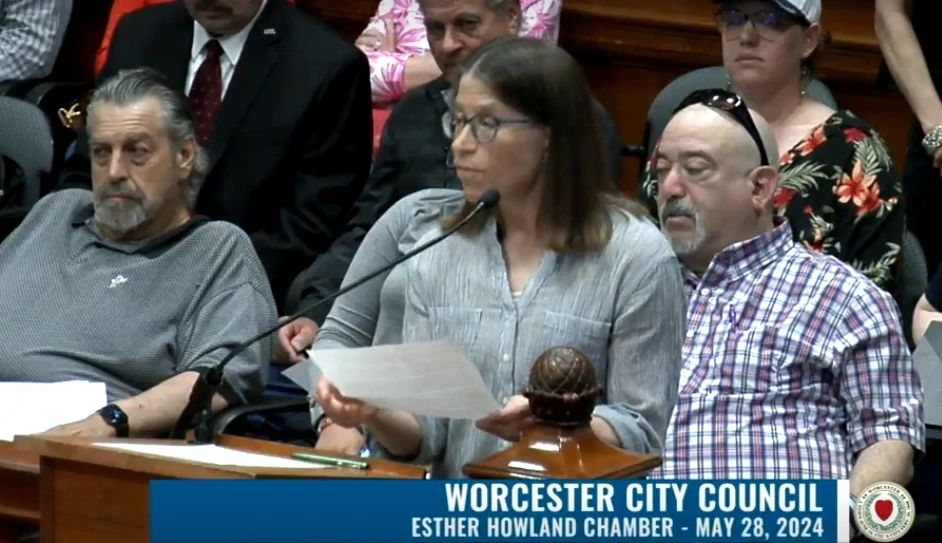
WORCESTER—Though the Boston Marathon is over a month behind us, the Worcester City Council got in a little long-distance work this week, laboring for nearly four and a half hours in what was its last scheduled meeting for three weeks.
The session’s length was belied by the dearth of debate on some highly anticipated items, with the council opting to postpone official discussion on several big ticket issues such as the ongoing rental registration program saga, debate over the Mill Street redesign, and a review on the number of claims the city has paid out to drivers with cars damaged by potholes.
While the council might have referred many of these items back to committee, members of the public voiced their opinions in the nearly two-hour public comments portion, with the Mill Street redesign drawing the most ardent pro and con proponents and the most heated debate.
Dozens of citizens stood up to speak on the subject referencing several items on the agenda, which includes a request by Councilor Morris Bergman for a report from the commissioner of transportation and mobility to provide the Worcester City Council with an assessment of what it would cost to return Mill Street to its original configuration.
Bergman also requested the city manager address the recent redesign changes and accidents to and on Mill Street to include the return of on-street parking up to the curb, provide best practices for the protection of bicyclists and pedestrians, allocate funds to engage a street design engineer to review the safety of the design changes, and send future changes to council for review and appropriate public hearings.
Councilor-at-Large and Vice Chairman Khrystian King also asked for a review of the Mill Street redesign “for the purpose of ruling in or out the potential for elevating protected bike lanes and the widening sidewalks with a dedicated walkway.” He said improvements should be completed through the use of federal funding received in the amount of $2 million.
“I’m fearful when I drive down the road,” said Len Zalauskus of Worcester. “It shakes me up. My father is 85, and he got his license 70 years ago, and he won’t go down the street anymore. You are used to parking next to the curb and that’s what you want to do. The road to me is dangerous. My wife and I are fearful going down the road.”
Jen Daly, who lives on May Street, said she recently stood out at the Big Y on May Street, “instead of complaining on social media,” to gather feedback and signatures regarding the Mill Street redesign.
“I decided to take the pedal to the metal and really ask the people,” she said. “In two or three hours of work, I gathered a lot of signatures—142 to be exact, to do the parking on the curb. I talked to many people who live on Mill Street and heard a lot of stories…a single mom had to shovel an extra 12 feet because there was a car parked and the truck couldn’t get to the end of their driveway. Randomly, people showed me pictures of damage done to their cars that were simply parked on Mill Street…10:30 at night…rear-ended…and the damage was really bad.”
Karin Valentine Goins, who is listed at the program director of Preventative and Behavioral Medicine at the University of Massachusetts Medical School, spoke during the public comment portion of the meeting, leading with her assertion that she’s spoken “countless times” on issues of transportation in Worcester, including as an advocate of the Safe Streets and Roads and Vision Zero initiatives.
Her biography reads, “Ms. Goins has a unique combination of training and experience in public health practice, research and community advocacy for active transportation. For nearly 20 years she has built connections at the state and local levels to understand and improve walking and bicycling conditions.”
“This time, I’m here to say I’m angry,” Goins said at the podium. “To those who would support these items, I would say, ‘How dare you. How dare you local elected officials with no transportation expertise presume the right to make road safety decisions. How dare you elevate opinions and misinformation of data and facts. How dare you continue to prioritize drivers’ convenience and familiarity over my safety as a person on a bicycle.’ You don’t have to ride a bicycle to support safety for those who do.
“Everyone knows change is hard. You could have leaned into that fact, educating yourself about innovations that increase safety for people outside of vehicles, and helping your constituents understand the value to the whole community of slowing down traffic with innovative designs and allocating roadway space for other modes. You could have led a campaign to discourage illegal passing on the right. Instead, you’ve chosen to ignore your expert city staff, including DTM [Department of Transportation & Mobility] and Worcester police, and listen to the cries of the local minority that falsely claims the redesign is responsible for multiple crashes.”
The massive 2023 redesign of the street was meant to promote safe lanes of travel for bicyclists and pedestrians and slow cut-through traffic on the flat, wide road known for its speeders.
The move to create bike lanes protected by public parking spaces along an almost two-mile stretch of Mill Street has generated both ardent support and opposition. With another $2 million of federal money in so-called Congressionally Directed Spending Requests (aka “earmarks”) imminent, debate is unlikely to slow anytime soon.
District 5 Councilor Etel Haxhiaj postponed action on Bergman’s items, along with several others related to Mill Street, until the council’s next regular meeting.
School funding
Interspersed in the public comments on Mill Street, several speakers, both parents and teachers from the city’s public schools, spoke in support of a request from the Educational Association of Worcester, the city’s teachers union, that the city makes good on prior funding shortfalls.
In a request to the council, Melissa Verdier, EAW president, said that the city had failed to meet the minimum funding obligations for the schools under state law for the past four years.
In her comments to the council, Verdier estimated the schools had been shortchanged approximately $6 million and included in her petition several memos from the state Department of Elementary and Secondary Education that showed, for example, a $3 million shortfall in fiscal year 2023, and a projected shortfall of just over $1 million for the current fiscal year.
While Verdier advocated for the city to meet one hundred percent of its budget obligation to the schools, she pointed out that many cities and towns exceed that floor.
“Boston is a gateway district, and we are not Boston but they pay one hundred and 37 percent of their minimum spending,” she said.
Under current projections, Worcester Public Schools faces a $22 million budget deficit.
The council next meets June 18.
Ted Flanagan is a journalist, novelist, and paramedic from central Massachusetts. During his time as a newspaper reporter he covered courts and crime for the Eagle-Tribune in Lawrence and was a general assignment reporter in the Fitchburg Bureau of the Worcester Telegram & Gazette. He can be reached at ted@tedflanagan.com