
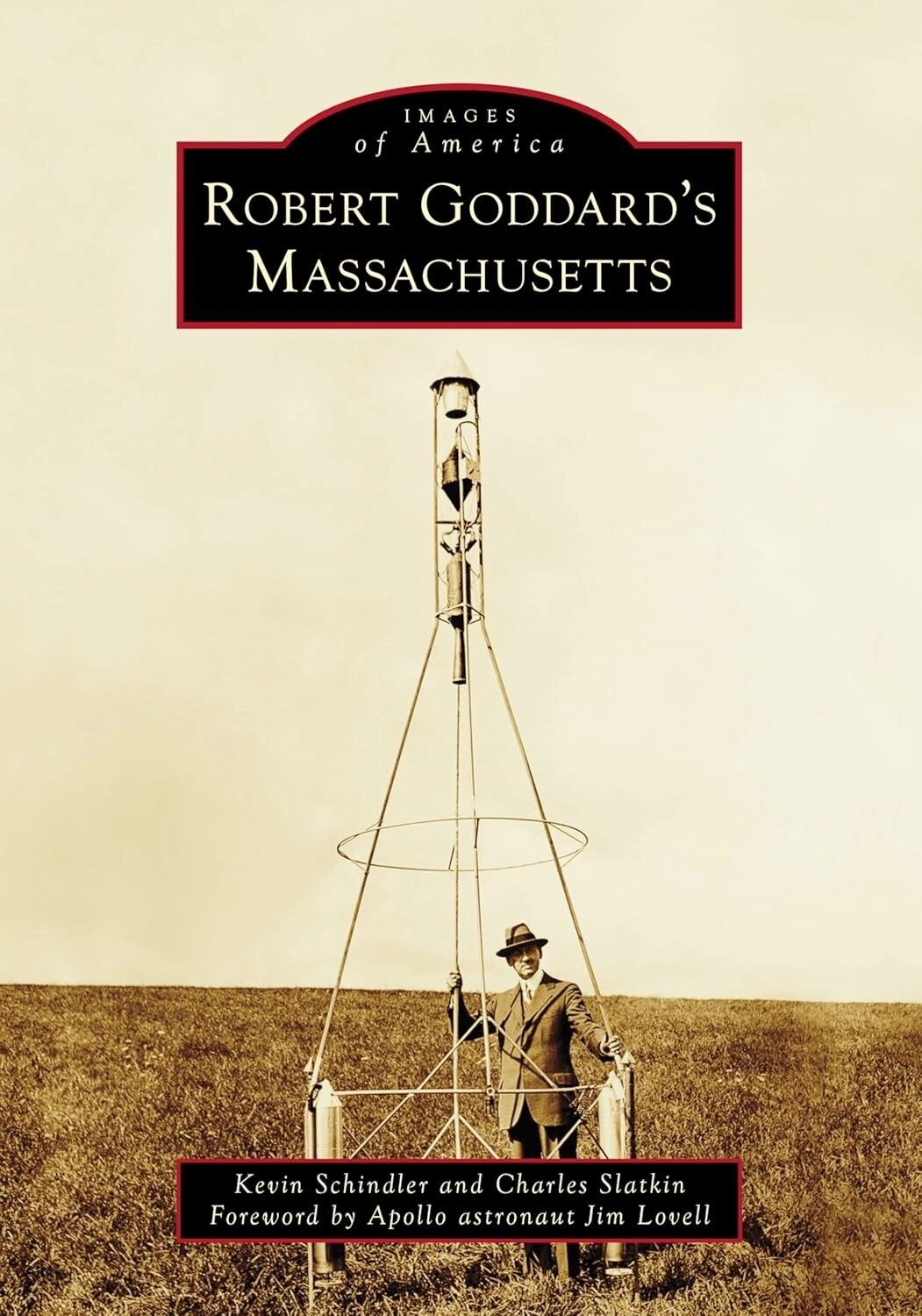
WORCESTER — As Central Massachusetts prepares to mark the 100th anniversary of the world’s first liquid-fueled rocket launch, a new book is inviting readers to look back at the local roots of the scientist who helped usher in the space age.
“Robert Goddard’s Massachusetts,” coauthored by Kevin Schindler and Charles Slatkin, drops March 3. Published by Arcadia Press as part of its Images of America series, the book traces Robert H. Goddard’s journey from his early years in Worcester to the snowy Auburn field where his 1926 experiment changed the course of history.
According to a PRNewswire announcement, Goddard launched a “modest, 10-foot rocket” on March 16, 1926, in Auburn. The rocket rose just 41 feet and traveled 280 feet downrange before crashing — but that brief flight proved liquid-fuel propulsion was possible and laid the foundation for the rockets that followed, from Earth-orbiting satellites to lunar missions and spacecraft exploring deep space.
The book features more than 200 historical photographs and follows Goddard’s work across Massachusetts landscapes where he tested engines and refined designs. A bonus chapter covers his later work, particularly in Roswell, New Mexico. The release also highlights the role of Esther Goddard, described as Robert’s wife, collaborator, research partner, launch photographer and cinematographer, whose efforts preserved his diaries, notebooks and experimental records.
Schindler, historian and public information officer at Lowell Observatory in Flagstaff, Arizona, said in the announcement, “Robert Goddard was a legendary scientist, engineer, and visionary, and his contributions forever changed our place in the universe. As the Wright Brothers enabled our conquest of the skies above, Robert Goddard drove us to the heavens beyond.”
Slatkin, founder and executive director of The Wonder Mission’s Goddard Project initiative, added, “Robert Goddard’s contributions are as significant as those of other American innovators such as Eli Whitney, Thomas Edison, and the Wright Brothers, yet sadly he is hardly known outside the science community. We hope this book and the centennial celebration of Goddard’s historic launch changes this and inspires future generations, our tomorrow’s Goddards, to think big and turn their dreams into realities.”
The book also includes a special foreword by Apollo 13 astronaut Jim Lovell, who reflects on Goddard’s influence on generations of explorers.
Born in Worcester in 1882, Goddard spent part of his youth in Roxbury before returning to Worcester as a teenager. During his high school valedictory address, he declared, “The dream of yesterday is the hope of today and the reality of tomorrow,” a line highlighted in the release as emblematic of his vision.
Centennial events ahead
The book’s release coincides with a packed slate of centennial events in Worcester and Auburn marking the March 16 anniversary.
Planned activities include a family celebration at Goddard Park in Auburn, programming and model rocket launches at the EcoTarium, a new exhibit at the Museum of Worcester titled “Worcester to the Stars,” tours of the Robert and Esther Goddard House on Tallawanda Drive, academic talks at Clark University and a culminating celebration at The Hanover Theatre.
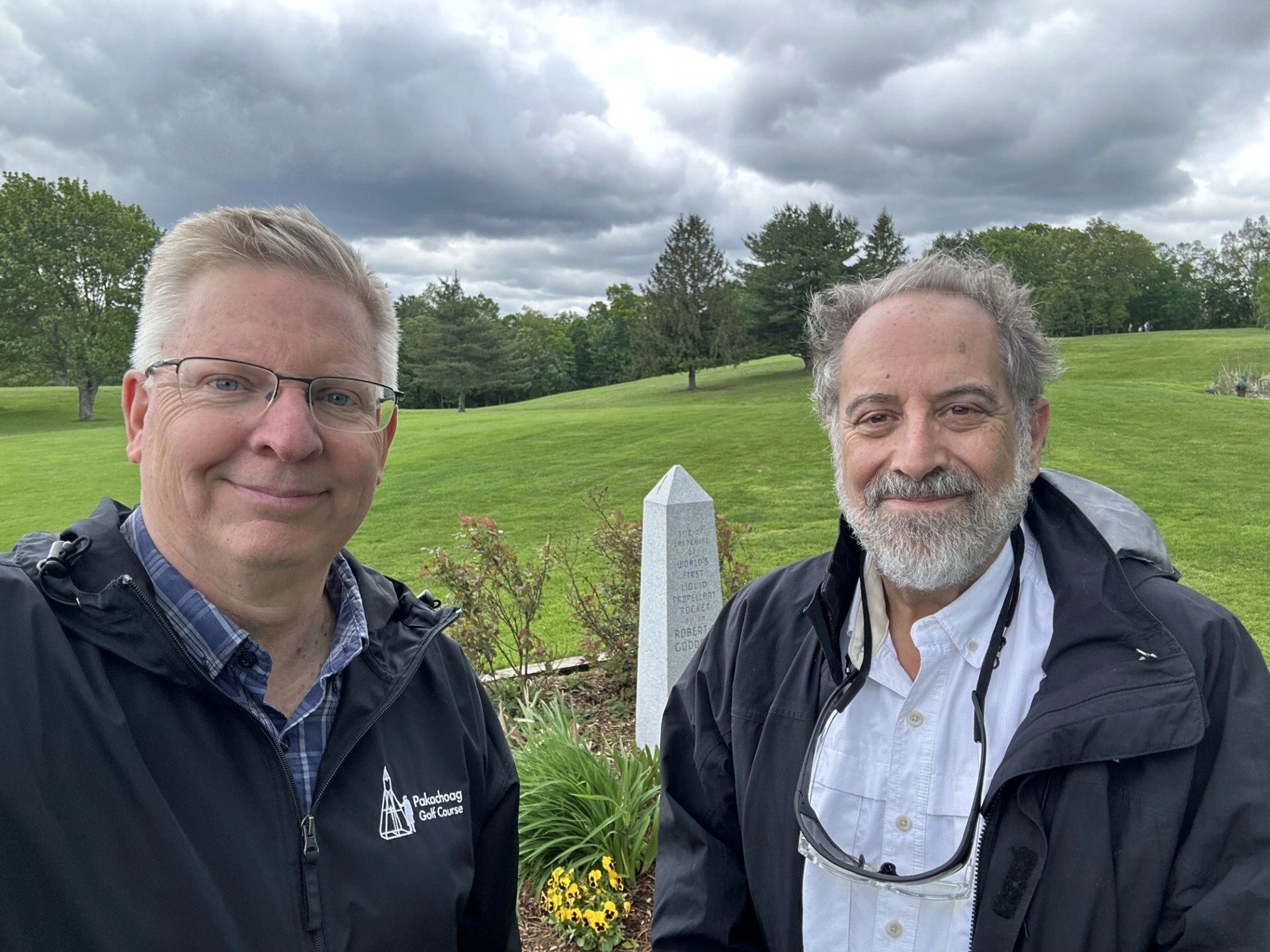
An official centennial event is scheduled for March 16 at Pakachoag Golf Course in Auburn — the site of the original 1926 launch — including a commemorative rocket launch.
A separate report will detail the full calendar of events and participating organizations.
For now, “Robert Goddard’s Massachusetts” offers a timely look at how a Worcester native’s imagination — first sparked, as the release recounts, while perched in a cherry tree — helped open the door to the modern space age.