
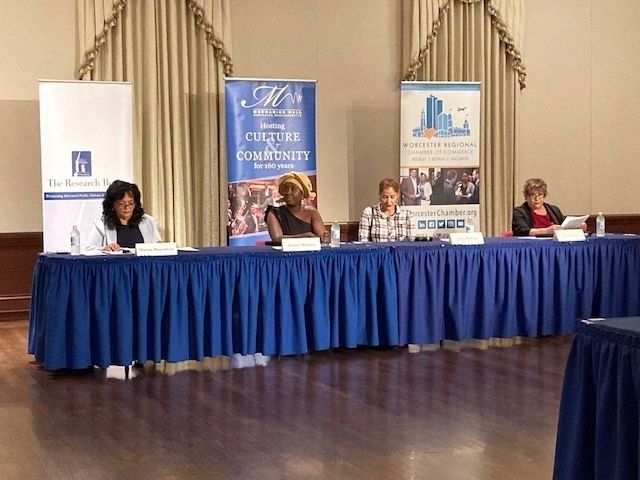
Much of the sparring that took place during a debate at Mechanics Hall on Oct. 4 between candidates running for contested Worcester School Committee district seats involved no knockout punches – just a lot of dodging and feinting broken up by the occasional jab.
The match involved none of the full-blown fisticuffs the small audience perhaps would have liked to see.
Not until Jermoh Kamara and Nelly Medina threw their most devastating shots, that is. But did they land?
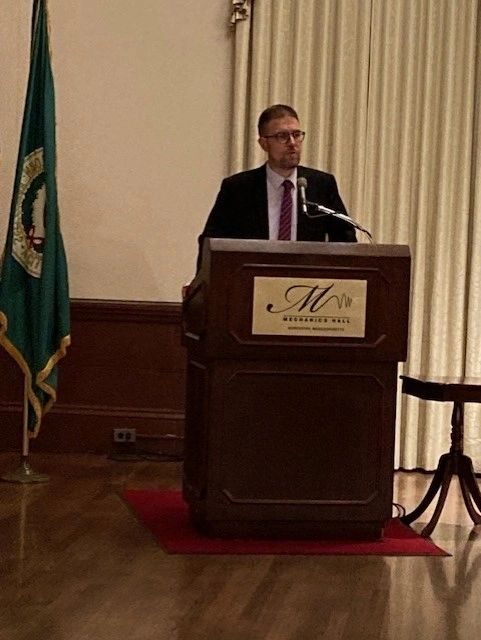
The program was sponsored by the Worcester Regional Chamber of Commerce, the Worcester Regional Research Bureau and the Telegram & Gazette and featured welcoming remarks and ground rules offered by the Bureau’s executive director and CEO Paul Matthews. It also opened with a cordial greeting from Kathleen Gagne, who is executive director of the city’s most cherished and historic meeting place (that would be Mechanics Hall, should there be any confusion).
Joe Corazzini and Laura Martinez served as moderators, and handled themselves ably and professionally.
The questions posed to Nelly Medina and Kathleen Roy, who are going head-to-head in District E, and Jermoh Kamara and Dianna Biancheria, who are pitted against each other in District C, were thoughtful and wide-ranging. Medina and Roy are both first-time contenders. Kamara is a sitting first-term member of the School Committee. Biancheria is a former six-term At Large member of the School Committee.
Of course, all four emphasized that Tuesday, Nov. 7 is Election Day. All four encouraged people to vote.
The districts are part of the newly drawn election map that created six slots: A, B, C, D, E, F. All but C and E on the district side feature principals who are running unopposed.
There are also four candidates angling for two At Large seats on the School Committee.
The candidates for district seats were asked to expound on such subjects as: What role should the School Committee play in governance of the system? Are the Worcester Public Schools doing enough for a diverse student population that includes a significant number of English Language learners? What are your feelings on a school safety audit? On MCAS? How can teachers confront the issue of learning loss related to social-emotional factors? Is funding the WPS receives being used effectively?
There were also queries related to outcomes under the duress of a relatively low system-wide income level that sometimes lacks updated technology, cell phones, social-emotional resources needed in the wake of the pandemic or necessary parental engagement. Questions also referred to the challenge posed by the success of Worcester Tech with its waiting list for entrance, the imminent release of a new strategic plan, and the status of school buildings.
In their opening and closing statements, the candidates defined themselves. Medina, for instance, said she is dedicated to grassroots organizing (“boots on the ground”) and advocacy and that she worked for the implementation of district representation through a voting-rights lawsuit. Biancheria said she has the endorsements of the Teamsters, AFL-CIO and Local 272 unions. Roy referenced her longstanding involvement in the community on different levels. “I am still called ‘Coach Roy,’” she said. Kamara identified herself as “the candidate of change” and said “I am a proud graduate of the Worcester Public Schools.”
There were subtle differences in their responses to the questions, with undertones of disagreement. On the future of MCAS as a requirement for graduation, for instance, Kamara offered: “I did well on MCAS but I don’t see it bringing the results” that are desired—career-wise. She said a greater emphasis needs to be placed on developing real-world skills in students. Biancheria said she was instrumental in developing a college-connection program. “What could be done differently?” she said. “One test won’t make them successful. We need an overhaul of graduation requirements.”
Even on a question related to “the next wave of projects” involving school buildings, the candidates were not far apart in their answers. Biancheria said the 62 buildings in the system need not just updating but ongoing maintenance to which Kamara swung back: “We have been on it.” Roy argued that maintenance needs are of utmost importance. Medina said “all schools across the country are in the same situation. We should retrofit all our buildings” that need this attention.
Any hostility between the candidates was not apparent, there were no warm embraces or pre-debate handshakes, either. Medina came in at the last minute and seemed to ignore Roy in taking her chair. The flash points came at the end, when Kamara and Medina took shots at their opponents. “It’s seven schools (in District C), not six–she forgot the Grafton Street School,” Kamara said of Biancheria. Biancheria chose not to rebut. Then, talking to the audience and not her foe, Medina said in her discussion with people on the campaign trail: “I have never heard of Kathy Roy.” Roy shot back: “People tell me ‘I have never heard of Nelly Medina.’”
Mechanics Hall will be the site of the next scheduled debate, for At Large seats on the City Council, on Wednesday, Oct. 11 at 7 p.m.
Rod Lee is a career journalist, a veteran of the media scene in Worcester and Central Massachusetts, and the author of seven books including the recently published “Gil Cristopher,” a novel about the difficulties associated with aging. He lives in Northbridge with his wife Marie. He can be contacted at rodlee.1963@gmail.com