
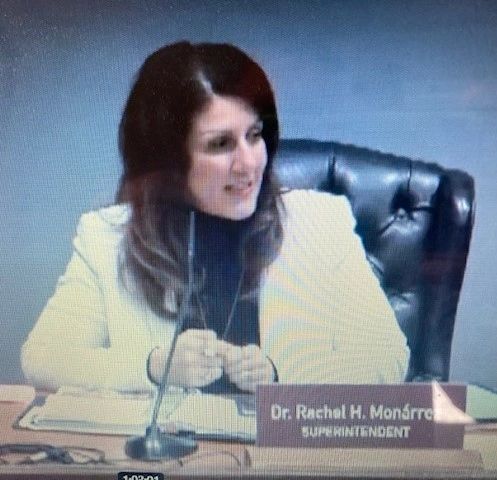
WORCESTER—A draft of the Worcester Public Schools’ new five-year strategic plan received a mostly positive endorsement at the Dec. 7 meeting of the Worcester School Committee, setting up what is expected to be an affirmative vote for adoption of the blueprint at the panel’s next session the Thursday before Christmas.
But this is not to say there wasn’t pushback, coming in large part from Tracy O’Connell Novick.
“This is really cool, let’s go,” Susan Mailman said, after Superintendent Dr. Rachel Monárrez and members of the task force charged with creating the document presented an overview of the plan. It consists of six priority concentrations: equitable resources and educational programs; family and community engagement; culture and climate; acquiring and retaining talent; health and wellness; and modernized and safe facilities.
“This is very robust,” Jermoh Kamara said. Kamara praised the nearly-finished product as “big-picture thinking but also a step-by-step approach.”
“This was a community initiative from the beginning,” Molly McCullough said. McCullough and her colleagues on the Standing Committee on Governance & Employee Issues voted unanimously to send the new strategic plan to the full school committee at their meeting on Nov. 28, after reviewing it themselves.
Mailman’s only question heading into formal ratification of the plan centered on how it will be rolled out and how often the School Committee will be receiving updates.
The superintendent assured Mailman that there will be continual evaluation as “we take ownership” of the plan. Another way of putting it, she said earlier, is “key performance indicators will be used internally to keep ourselves on track.”
O’Connell Novick, however, expressed hesitancy about aspects of the plan.
“I review this similarly to how I look at our budget,” she said, at the start of lengthy comments she made. “I find myself very puzzled, frankly, by the strategic plan process that’s actually in this document, because what we saw this evening in the actual presentation was actually the strategic plan process.”
O’Connell Novick also asked administration to “move away from the acronym KPI,” for “key performance indicators,” remarking, “I don’t need another acronym.”
She asked: “Do the goals support the aim and do the KPIs support the goals?”
Pointing to the month of December as an especially hard time for some students, she said elves in classrooms is unacceptable. “It is incredibly harmful to our kids,” she said. “It is entirely possible to be festive without being discriminatory. Too many kids feel like they don’t belong.”
O’Connell Novick also said there is a need for the five-year capital plan to be “more explicit.”
The superintendent asked O’Connell Novick to submit her requests for changes in writing, commented that she was “excited” to see the new strategic plan come together as it has. She noted that the task force charged with developing the plan received a lot of input, which has been “synthesized” into the six target areas.
“We will each and every day work to see that the goals” to be implemented for 2023-2028 come to fruition, she said. “Our promise to the future,” as the plan has been dubbed, represents the district’s “mission, vision and core values,” she said.
Much of what was discussed at the meeting will make goal number 3, which addresses “culture and climate,” one of prime importance. While the superintendent noted that recommendations coming out of a “listening and learning tour” were heard “loud and strong” on the matter of culture and climate, later in the meeting a man who was identified as “Felix B” called to complain about “bullying and harassment” his son was subjected to by another student. He said he was turning to the superintendent and the school committee in a last desperate attempt to have the matter handled satisfactorily.
This tied to remarks Mailman made a little later on in asserting that an issue of alleged abuse in the 1990s was not handled in a climate and culturally-sensitive way, with “the safety and wellness of kids” in mind.
Toward the end of the meeting, O’Connell Novick expressed a continuing lack of confidence in Commissioner of Education Jeffrey Riley, citing his proposal for dealing with “chronic absenteeism” by applying “a stick but no carrot” approach.
“It is not actually dealing with the problem,” which grew out of the pandemic and is affected by students’ mental-health struggles and their perception that school is not always a friendly place, she said.
Rushing and changing the accountability system is not the way to go, O’Connell Novick said.
“Someone needs to say to the Board of Education, ‘this is a mistake,’” she said.
Editor’s note: This revised version of coverage of the Worcester School Committee meeting of Dec. 7 contains several corrections relating to comments made by Member Tracy O’Connell Novick.
Massachusetts Secretary of Education Patrick Tutwiler was incorrectly referenced in the original article, and has been updated to the correct name and title.
Rod Lee is a career journalist, a veteran of the media scene in Central Massachusetts and the author of seven books including the recently published “Gil Cristopher,” a novel about the difficulties associated with aging. He can be contacted at rodlee1963@gmail.com
