
WORCESTER—Transporting 60 tons of cannons 300 miles from upstate New York to Boston during the winter of 1775-1776 paved the way for what is considered to be the first major victory for the U.S. in the Revolutionary War.
Continental Army Colonel Henry Knox led the daring 56-day journey along what is now known as the Knox Trail, triggering the British evacuation of Boston after an 11-month occupation that began on April 19, 1775, with the Battles of Lexington and Concord.
This is the 250th anniversary of the Knox Trail expedition, which winded through Worcester in 1776. Part of the commemoration takes place on Saturday, Jan. 31, at 2 p.m. at the AC Hotel by Marriott, 125 Front St., in downtown Worcester. It’s a free event and the public is encouraged to attend.
The program was originally scheduled to be held at the American Antiquarian Society but was moved to the AC Hotel to accommodate a larger audience, according to Jonathan Lane, executive director of Revolution 250, which is organizing the event. Lane said the switch was made after Knox Trail programs in Great Barrington and Springfield drew larger crowds than expected.
Lane said Scott Casper, AAS president, and Nan Wolverton, AAS vice president for academic and public programs, have been invited to speak at the program.
“We want to make sure that Worcester gets its just due in telling this commemorative story,” Lane said, “because it’s an important community, going all the way back to 1765 with some of the earliest protests against the Stamp Act.”
Lane and his wife lived in Oxford for 15 years, but moved to Rhode Island after their two sons graduated from St. John’s High School.
Knox was born and raised in Boston and during the Boston Massacre on March 5, 1770, he unsuccessfully tried to convince the British soldiers to return to their quarters. He was only 25 years old when he led the transport of 43 cannons, six coehorns, eight mortars and two howitzers, all captured from forts on Lake Champlain. The artillery was carried on sleds and wagons drawn by horses and oxen from Fort Ticonderoga and Crown Point through deep snow, across frozen lakes and rivers and over the Berkshire Mountains.
The Massachusetts Historical Society in Boston was founded in 1791 as the first historical society in the U.S. and it houses Knox’s diary, which documents his journey to deliver the artillery to Boston. Kanisorn Wongsrichanalai, MHS chief historian, pointed out that contrary to what people might think, Knox purposely waited for cold weather so the ice could freeze thick enough to cross and the snow could help him pull the sleds across the land.
While the expedition stopped in Framingham to build carriages for the cannons, Knox rode ahead and met with General George Washington in Cambridge on Jan. 24, according to Wongsrichanalai.
On March 2, Knox ordered the cannons to fire on Boston. Two days later, the cannons were moved to higher ground at Dorchester Heights and fired again. Finally, the British left Boston for Nova Scotia on March 17, which has become known as Evacuation Day as well as St. Patrick’s Day.
“If you want a human story,” Wongsrichanalai said, “this is a story of a fellow who’s trying to get back home and rescue his hometown.”
“Without the victory in Boston that occurred on the 17th of March, 1776,” Lane said, “I don’t think you get the Declaration of Independence in July of 1776. It may have come eventually, but not that early because they needed a sign that the people were committed to fighting for independence.”
Wongsrichanalai explained that the diary is about 30 pages long and begins on Nov. 17, 1775, when Knox departed Boston for upstate New York, and ends in early January before the journey reached Worcester. Several pages were ripped from the diary and Wonsrichanalai believes they were used to make notes for other purposes.
The only mention of Worcester in the diary is on the first page when Knox wrote on Nov. 20, 1775, that he paid two bills of $7 and one of $6 for transportation in Worcester. Knox began his journey with about $1,000 in his pocket from Washington.
Knox moved his wife Lucy to Worcester for her safety after he joined the Continental Army following the Battles of Lexington and Concord, and Lane said they reunited for the first time in months when the artillery train passed through.
Lane said he imagines that Knox remained in Worcester at least long enough to dine with his wife.
Knox and his brother William were the only ones who traveled all the way from Boston and back. Other people and equipment from towns along the way were hired to help as the expedition passed through. In all 160 horses and oxen pulled 42 sleds.
“It really is a great demonstration of how difficult it is,” Wongsrichanalai said, “to wage 18th century warfare in a rural environment like North America, but it also shows that people from different colonies can work together.”
Washington promoted Knox to the rank of general and to the position of chief of artillery and he helped plan and carry out Washington’s successful surprise attack on the British in Trenton, N.J., after a Christmas night crossing of the Delaware River in 1776.
Knox later served as the country’s first secretary of war and played an important role in selecting Springfield as the site of the first federal armory in 1777. Fort Knox in Kentucky and Fort Knox in Maine are named after him.
Local civic leaders and representatives of Brookfield, Spencer, Leicester, Shrewsbury and Northborough, through which the artillery train also passed, will be on hand for the program at the AC Hotel on Jan. 31.
The public is also able to view a short video about the Knox Trail and read about and hear stories about the artillery’s journey through central Massachusetts.
Lane said he’s working with city officials to allow reenactors with horses and sleds, accompanied by fifes and drums, to march at 1 p.m. from Elm Park to City Hall. Lane said he’s trying to arrange with the city to allow a cannon to be fired after the program at Worcester Common or the open area across from the hotel. At minimum, he expects muskets to be fired.
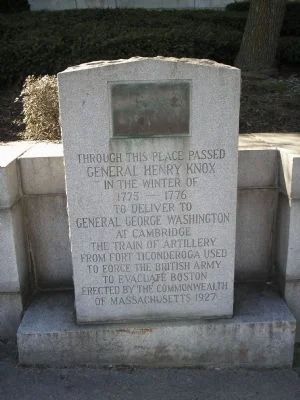
In 1927, the year following the 150th anniversary of Knox Trail, granite monuments were erected at 56 locations along the route, one for each day of the expedition. A granite monument stands outside of the former Worcester County Courthouse at the corner of Main and Highland streets.
All of the monuments were inscribed the same: “Through this place passed General Henry Knox in the winter of 1775-1776 to deliver to General George Washington at Cambridge the train of artillery from Fort Ticonderoga used to force the British Army to evacuate Boston.”
“I think it’s really important to remind people of the history that took place in their backyard,” Wongsrichanalai said. “We hope that it’s inspirational for people and gets them to want to learn more about history.”
Bill Doyle has been a professional journalist for 47 years, most of them as a sports writer for the Telegram & Gazette. He covered the Boston Celtics for 25 years and has written extensively about golf, boxing and local high school and college sports. He also worked for the campus newspaper when he attended UMass-Amherst. He can be reached at billdoyle1515@gmail.com
