
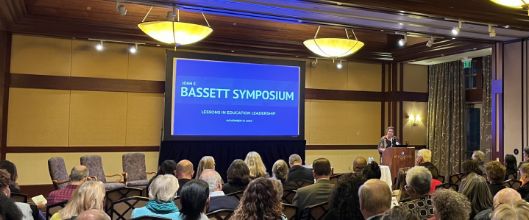
WORCESTER, MA – Worcester’s superintendent and the president of Nellie Mae shared lessons they’ve learned in education to a full house for the Worcester Education Collaborative‘s inaugural John E. Bassett Symposium last week.
Dubbed a “fireside chat,” the new symposium named after the WEC’s founder took place at the Beechwood Hotel, and featured Dr. Rachel Monarrez, superintendent of Worcester Public Schools, and Dr. Gisele Shorter, president and CEO of the Nellie Mae Education Foundation.
The goal of the new symposium is to create a platform to dive deeper into issues around Worcester education and its support systems.
Kicking off the event, WEC’s Executive Director Jennifer Davis Carey, said: “Worcester, the second largest city in New England and growing, is at an inflection point,” said an announcement. “With new leadership open to what is possible, new funding through the state Student Opportunity Act, and a new configuration of and membership on the School Committee, we are at a once in a generation moment to make substantive, long term meaningful change in our education system and by doing so, assure a strong a vibrant future for our city and its residents.”
The “fireside chat” specifically called attention to the importance of building relationships with business and civic leaders when developing responsive, equitable approaches to education that best serve the needs of all students, according to the announcement.
“Who else needs to be in this work with you?” asked Shorter. “And do you have the friends to bring them to the table?” If the superintendent spends the bulk of their time thinking about how to build will and demand, who has their eyes on the outside? Those are the things I think chambers can do, coalitions, school board members, and committees.”
The goal of the Bassett Symposium, Carey told the Worcester Guardian, is to facilitate deep conversation on foundational issues and opportunities in public education.
“We anticipate that the result will be a public more informed and engaged in the work of education in our city and beyond,” she said.
Bassett, the evening’s honored guest, closed the program with a nod to the city’s ecosystem and its unique ability to respond to today’s challenges in education, continues the announcement.
“Worcester has been blessed in some very specific ways,” said Bassett. “We have family foundations here that make things possible that are not possible in many other places. We also have a very supportive business community that has continued to support the education of all the young people in this community because they know their future employees are coming out of those educational systems,” he said, “I’m so proud of what the Worcester Education Collaborative has been doing. It’s truly a national model. I hope it can get some attention so it can be a model for other communities.”
Carey echoed Bassett’s message when asked by the Worcester Guardian how Worcester’s educational infrastructure is uniquely structured to handle and manage education issues perhaps better than other communities.
“Worcester has deep assets in its varied higher education sector,” she said, “a vibrant creative and cultural sector, burgeoning 21st century businesses, an engaged philanthropic community, and a population representative of the increasing pluralism of our nation.”
With new funding through the state’s Student Opportunity Act, coupled with increased opportunities for federal funding from a variety of sources, Carey said the “creative, visionary and experienced” leadership team in the WPS’s district office has the ingredients for an exceptional system of schools.
“If we consider and address education as an eco-system,” she added, “with each sector offering something distinct to complement the hard work being done in the schools, we will be successful in offering what is best for our children.”
Email Charlene Arsenault at carsenault@theworcesterguardian.org